
Is the longevity movement neglecting the population that needs it most? Is the longevity movement focused on areas of marginal gains while neglecting the low hanging fruit that has the biggest impact? Likely yes, and that’s why coaches remain of critical importance.
I debated writing this post for a while, but it’s been on my mind incessantly so I decided that I should put pen to paper and have at it.
Recently, it seems that every other topic that comes up in conversation or is delivered into my email and social feeds is about longevity. GLP-1’s, health span, life span, blood tests, supplements, wearable health trackers… the list goes on.
And I get it. I want to live as best I can and for as long as I can. And up until a few weeks ago, I didn’t think twice about the messaging coming from longevity-related businesses and thought leaders in that field.
My Bias

I realize that for the better part of my life, I’ve been living in a bubble. I went to Springfield College where most everyone was an athlete of some type. After graduating, I moved to Manhattan and worked in the fitness industry. And now I live in Colorado, where climbing 14’ers is as normal as going grocery shopping. Add to the tally that I run an endurance sports education company, and it’s easy to see why I have an incredible bias with respect to what the ‘norm’ is in relation to health.
However, my outlook on health and longevity all changed when I recently spent a week at Disney World. What I saw at Disney World shocked me. The majority of visitors were obese and many could likely be classified as severely obese.
This observation trends with the Center for Disease Control’s 2024 survey that 40.3% of the US population is obese (based on Body Mass Index). Even more shocking, a recent study (2025) by Harvard Medical School researchers found that 70% of Americans may be classified as obese based on fat distribution and BMI. In other words, the US is a sick country. This may explain why the US spent approximately 4.9 trillion (with a T) on healthcare in 2023!
Marginal Gains
My observation at Disney World hit me like a ton of bricks. Most of the longevity stuff that is being marketed could largely be considered marginal gains. And by that, I mean that many of these companies offer products and services that assume that I’m already healthy. These companies are essentially marketing themselves to people that are already aware of the importance of health, are at an advanced stage in their health journey, and most importantly, are willing to pay for services/products (ex: trackers, supplements, blood testing, medical scans, etc…) to continue to make themselves even healthier. I’m guessing that most non health-conscious people are not aware of companies like Eternal, Inside Tracker, Whoop, etc… because they are not the desired demographic of these health/longevity-focused companies.
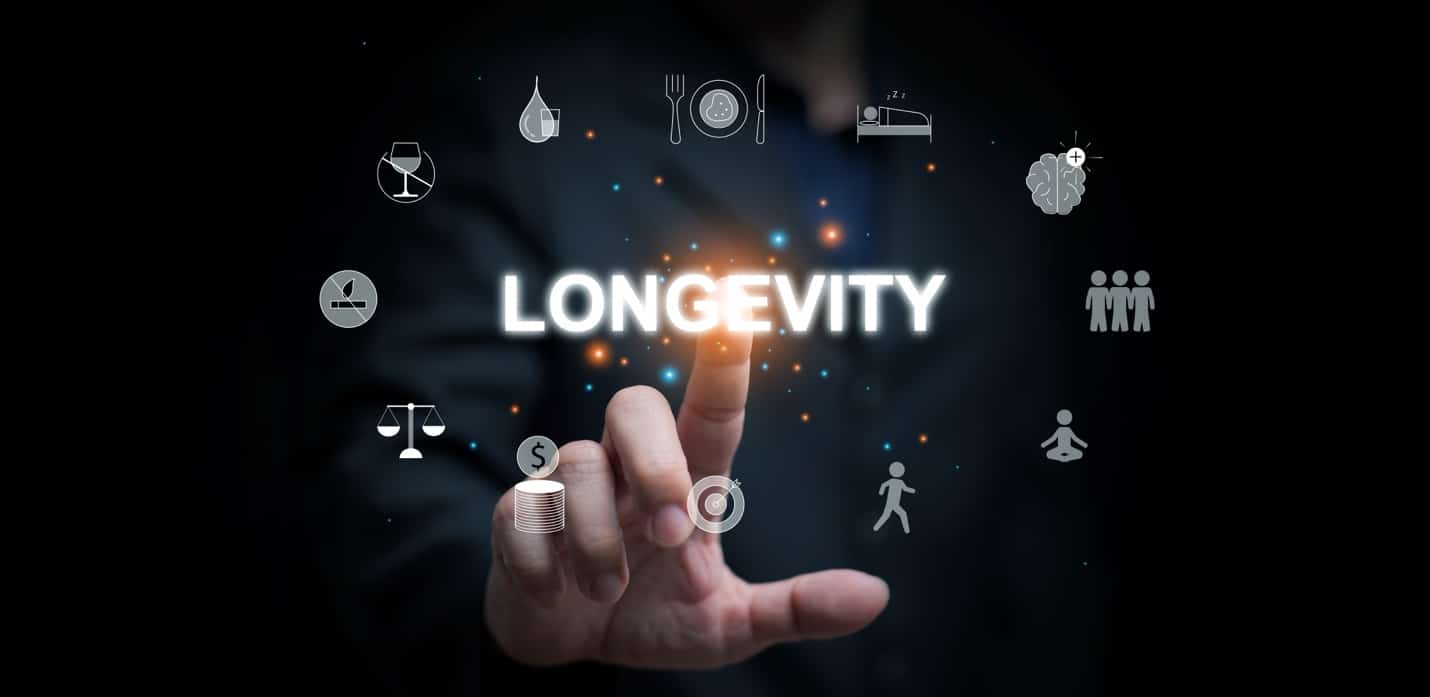
To be clear, I have no problem with already apparently healthy people wanting to be even healthier. However, with respect to the health and longevity of the general population, the focus needs to be on the low hanging fruit (eat whole food, exercise, reduce stress, focus on sleep, etc.) which, in my opinion, represents at least 95% of one’s health. The last small percentage is made up of the current longevity areas being heavily marketed today.
Cycling Analogy
As a longtime cyclist, I feel that the current focus on longevity with respect to monetization reflects the commercialization of the cycling industry. The largest performance gains you can get with respect to cycling are from consistent and properly structured training and a properly fitted bike to maximize one’s comfort and efficiency. In contrast to that, most of the marketing these days are things like one-piece carbon fiber cockpits that claim to save 2 watts, titanium pedal spindles that save 10 grams and carbon fiber chainrings that weight almost the same as aluminum ones but look cooler!
Because here is the reality. The difference in performance between a $150 bike from Wal-Mart and a $4,000 bike from a bike store is massive. However, the difference between a $4,000 bike and a $15,000 bike… marginal gains.
Not Trying to Be a Hater
As noted above, I have no problem with self-betterment, especially when it pertains to one’s health. But what I realized is that with respect to the health of the general population, most of the population… and the part of the population that needs the most intervention is not being addressed or even noticed with respect to the longevity movement. There is a plethora of reasons why this is likely the case which I’m not going to delve into here, but clearly this is a complicated issue without a clear answer.
The Fundamentals

At the most basic level, longevity is a pretty simple concept:
In my line of business, several of the hot topics regarding athletic performance surrounds topics like: zone 2 (low intensity) versus interval intensity, high carb vs. low carb fueling, heart rate variability scores, etc… However, regarding the general (i.e., non-athlete) population, these areas have little to no importance or relevance. What does have importance are the basics as noted above.
In that same vein, I don’t care if you’re an Ironman triathlete or a sedentary, ‘obese’ individual – if you’re not focusing on the aforementioned five areas of health, any amount of money or effort put into areas of marginal gains will likely be in vain.
Education
Currently there is a lot of noise in the longevity space without much of a filter. This filter is education. My hope is that as the longevity movement continues, there will be non-biased and science-based educational resources in easy-to-understand mediums available so that consumers can determine what longevity resources they want to utilize, if any.
Summary
I completely get the focus on longevity. As noted above, the US healthcare is almost exclusively focused on intervention versus prevention. As such, with respect to preventative health and maximizing one’s health and lifespan, many people are realizing that no one is coming to save them – especially not the medical or pharma industries. Therefore, the only one that can ‘save’ oneself is themselves – hence the focus on longevity and personal health.
As noted previously, I don’t have an answer to this national/global health issue, but the point of this post is to highlight that the current longevity movement/focus is likely moving the needle for those that are already apparently healthy, but not for those who are unhealthy. In other words, the population that needs the most attention is not getting it.