
Gut training should solve an ultrarunner’s fueling problem, not create a carbohydrate-eating contest. Here’s how to optimize carbohydrate intake by gradually increasing fueling amounts and race-like training conditions as tolerance improves.
Article by Gregor Rasp, CSCS and UESCA-Certified Ultrarunning Coach

An athlete can carry enough carbohydrate to fuel an entire ultra and still end up barely eating later in the race. Having fuel available is not the same as being able—or willing—to consume it.
Gut training for ultrarunners can help address these issues.
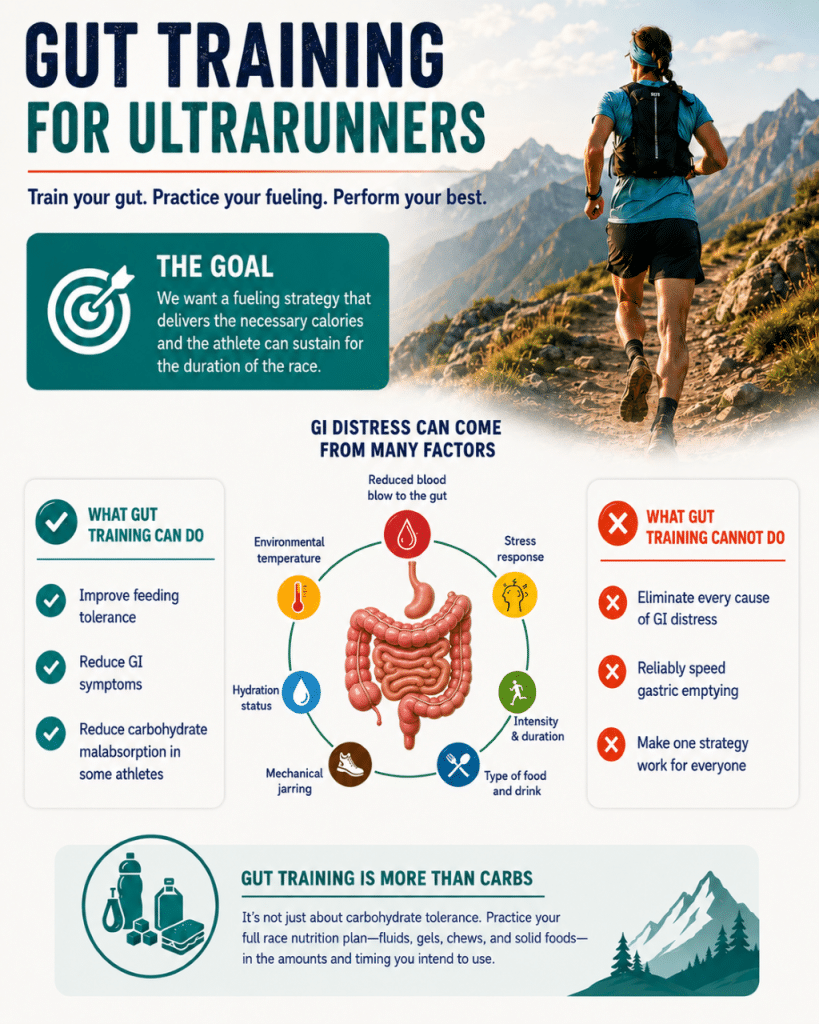
Gut training means repeatedly practicing the carbohydrate sources, fluids, products, amounts, timing and food types an athlete plans to use during competition. Research suggests repeated exposure can improve feeding tolerance, reduce gastrointestinal (GI) symptoms and, in some athletes, reduce carbohydrate malabsorption. It does not, however, appear to reliably speed gastric emptying or protect the gut from all the physiological stressors of prolonged exercise (Martinez et al., 2023).
Gut training is not only about carbohydrate tolerance. It means practicing tolerance for the complete range of race fuel an athlete intends to use. Carbohydrate is a major focus because it is a key fuel during prolonged exercise, while the amount, concentration, type and frequency consumed can strongly influence GI tolerance.
Most direct gut-training research has focused on carbohydrate and fluid feeding, so the evidence for adaptation is strongest in these areas.
GI Problems Are Not Just a Fueling Problem
GI symptoms during endurance exercise usually have multiple causes. Contributors include reduced blood flow to the gut, the physiological stress response, environmental temperature, hydration status, exercise intensity and duration, mechanical jarring, and the amount and type of food or fluid consumed (Costa et al., 2025).
Gut training cannot fix every GI problem, but it can help athletes better tolerate and execute their fueling strategy under exercise stress.
Feeding tolerance is broad. It encompasses not only carbohydrate dose and type, but also volume, concentration, feeding frequency, texture, taste or flavor fatigue, appetite, thirst, and tolerance of food and drink (Costa et al., 2025).
As a coach, you should ask, “What does this athlete need for the race, and can they reliably tolerate it?” rather than “What is the maximum amount of carbohydrate they can consume?”
How Gut Training Can Help
In one intervention study, recreationally competitive endurance runners repeatedly consumed carbohydrates during one-hour, moderate-intensity runs over two weeks. GI symptoms fell substantially, carbohydrate malabsorption decreased in one condition, and running performance improved (Costa et al., 2017).
A later systematic review found a similar pattern: Repetitive feeding generally improved gut comfort and sometimes reduced GI symptoms and carbohydrate malabsorption, but gastric emptying and intestinal integrity did not consistently improve (Martinez et al., 2023).
Athletes relatively new to structured race fueling may have more room to adapt than highly trained athletes already accustomed to high carbohydrate intakes (Martinez et al., 2023). If an athlete already tolerates the planned race intake, the priority may instead be confirming that the strategy remains tolerable over longer durations and under race-specific conditions.
How Much Carbohydrate Should Ultrarunners Take?
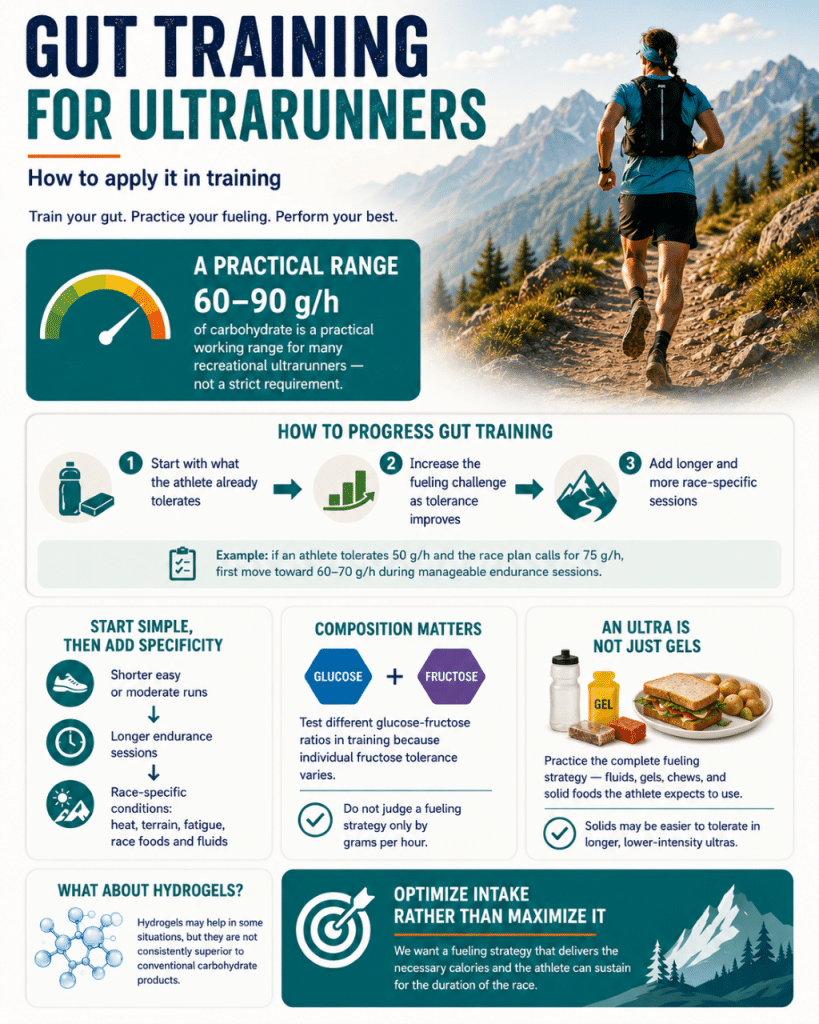
Individual requirements vary with event duration and intensity, body size, fueling opportunities and tolerance, but 60-90 grams of carbohydrate per hour is a practical working range for many recreational ultrarunners—not a strict requirement.
Very high intakes above 90 grams per hour have attracted considerable attention, with some elite athletes consuming 100-120 grams per hour or more. These higher intakes can increase exogenous carbohydrate oxidation, but current evidence does not consistently show additional performance benefits and more carbohydrate does not necessarily spare more of the athlete’s own carbohydrate stores (Plews et al., 2026). Some exceptional athletes may be able to utilize very high intakes, but that does not make them necessary for everyone.
Optimize intake rather than maximize it. Gut training should solve an athlete’s fueling problem, not create a carbohydrate-eating contest.
How Coaches Can Progress Gut Training
The research landscape is diverse and does not yet provide a single evidence-based gut-training protocol. Coaches and athletes, therefore, need to use the available evidence as a framework, individualize it and experiment in training.
Start with what the athlete already tolerates. Shorter, easy or moderate endurance sessions can be useful starting points for gut training because they allow the athlete to focus on fueling without also dealing with extreme duration, fatigue, technical terrain or heat.
Gradually increase the fueling challenge as tolerance improves.
When increasing carbohydrate intake, change one variable at a time. If an athlete tolerates 50 grams per hour and the race strategy calls for 75 grams per hour, first move toward 60-70 grams per hour during manageable endurance sessions rather than increasing carbohydrate intake and run duration together.
Once the planned hourly intake becomes comfortable, extend the duration over which the athlete repeatedly feeds. Then, add race-specific stressors: longer runs, terrain, heat where relevant, accumulated fatigue, and the actual foods and fluids expected on race day.
In practical terms: Start simple, then add specificity. First teach the athlete to tolerate the fueling strategy; later teach them to execute it under race-like conditions.
Waiting until the final few long runs leaves little room to adjust. A practical window may be roughly six to 10 weeks, though this is coaching guidance rather than a proven optimal protocol (Jeukendrup, 2017).
The Carbohydrate Type Matters
Combining glucose or maltodextrin with fructose allows carbohydrate to be absorbed through more than one intestinal pathway, supporting higher delivery rates.
The traditional 2:1 glucose-to-fructose ratio is no longer the only approach. Ratios closer to 1:0.8 or 1:1 may support higher carbohydrate delivery, but because individual fructose tolerance varies, athletes need to test different ratios in training rather than assuming one ratio fits all.
Avoid judging a fueling strategy solely by grams per hour. Composition and tolerance also matter.
Fueling for an Ultra Requires More Than Gels
During very long races, appetite and food preferences can change, and some athletes tire of sweet drinks, gels and chews. Because intensity is often lower in longer ultras, solid foods may also be easier to tolerate (Tiller et al., 2019).
Not every ultrarunner needs sandwiches or savory foods. Practice whatever the athlete expects to use. If solids are part of the race plan, test them during training rather than introducing them halfway through the race.
The same applies to fluids. Gut training should rehearse the complete fueling strategy.
What About Hydrogels? Hydrogel carbohydrate products are promoted to reduce GI distress at high carbohydrate intakes, but they are not a silver bullet. A systematic review found no consistent improvement in GI tolerance or performance compared with conventional carbohydrate products (Li et al., 2026).
Know Your Scope of Practice
Coaches can help athletes practice and refine race-fueling strategies, including establishing what an athlete currently tolerates and refining carbohydrate and fluid intake, timing, products and race execution. But keep in mind your scope of practice as a coach.
Persistent GI problems, therapeutic dietary interventions or more complex individualized nutritional needs warrant referral to an appropriately qualified sports dietitian (Costa et al., 2025).
Final Thoughts
Gut training for ultrarunners should be treated as part of race preparation, not as a race-week decision.
Start with what the athlete already tolerates, determine a fueling target appropriate for the event and increase the fueling challenge as tolerance improves. Then, extend that strategy into longer and more race-specific sessions until the athlete can execute their fueling strategy under fatigue and race-like conditions.
Remember that the goal is not the highest possible carbohydrate intake. We want a fueling strategy that delivers the necessary calories and that the athlete can sustain from start to finish.
References
Costa, R. J. S., Gaskell, S. K., Henningsen, K., Jeacocke, N. A., Martinez, I. G., Mika, A., Scheer, V., Scrivin, R., Snipe, R. M. J., Wallett, A. M., & Young, P. (2025). Sports Dietitians Australia and Ultra Sports Science Foundation joint position statement: A practitioner guide to the prevention and management of exercise-associated gastrointestinal perturbations and symptoms. Sports Medicine, 55, 1097–1134. https://doi.org/10.1007/s40279-025-02186-6
Costa, R. J. S., Miall, A., Khoo, A., Rauch, C., Snipe, R., Camões-Costa, V., & Gibson, P. R. (2017). Gut-training: The impact of two weeks repetitive gut-challenge during exercise on gastrointestinal status, glucose availability, fuel kinetics, and running performance. Applied Physiology, Nutrition, and Metabolism, 42(5), 547–557. https://doi.org/10.1139/apnm-2016-0453
Jeukendrup, A. E. (2017). Training the gut for athletes. Sports Science Exchange, 30(178), 1–5. https://www.gssiweb.org/sports-science-exchange/article/training-the-gut-for-athletes
Li, P., Song, Q., & Xu, N. (2026). Plant-derived alginate polysaccharide hydrogels in sport and exercise nutrition: Implications for carbohydrate metabolism, gastrointestinal integrity, exercise recovery, and athletic performance. Frontiers in Nutrition, 13, 1774380. https://doi.org/10.3389/fnut.2026.1774380
Martinez, I. G., Mika, A. S., Biesiekierski, J. R., & Costa, R. J. S. (2023). The effect of gut-training and feeding-challenge on markers of gastrointestinal status in response to endurance exercise: A systematic literature review. Sports Medicine, 53, 1175–1200. https://doi.org/10.1007/s40279-023-01841-0
Plews, D. J., Booth, P. D., Krieger, T., & Maunder, E. (2026). Fuelled or fooled? Examining the evidence and mechanisms behind ultra-high carbohydrate intake in endurance athletes. Sports Medicine. Advance online publication. https://doi.org/10.1007/s40279-026-02462-z
Tiller, N. B., Roberts, J. D., Beasley, L., Chapman, S., Pinto, J. M., Smith, L., Wiffin, M., Russell, M., Sparks, S. A., Duckworth, L., O’Hara, J., Sutton, L., Antonio, J., Willoughby, D. S., Tarpey, M. D., Smith-Ryan, A. E., Ormsbee, M. J., Astorino, T. A., Kreider, R. B., … Bannock, L. (2019). International Society of Sports Nutrition position stand: Nutritional considerations for single-stage ultra-marathon training and racing. Journal of the International Society of Sports Nutrition, 16, 50. https://doi.org/10.1186/s12970-019-0312-9
About the Author
Gregor Rasp, CSCS and UESCA-certified ultrarunning coach, is the founder of Top Of The Trail, specializing in trail and ultrarunning. As an athlete himself, he has over 15 years of experience in endurance sports. His coaching focuses on understanding performance physiology and the long-term development of athletes. Website: topofthetrail.com Facebook: topofthetrail