
How to spot decoupling in an athlete’s training data, and evidence-backed strategies to train durability for trail ultrarunning.
Article by Gregor Rasp, CSCS and UESCA-Certified Ultrarunning Coach

In the first article in this series, we explored why runners fade in trail ultras and introduced “durability” as the fourth pillar of endurance performance. Durability is the ability to maintain performance deep into a long race, when fatigue is relentlessly chipping away at everything.
Now it’s time to get practical. This article covers how to spot durability breaking down in training data—and how to train durability for trail ultras.
Spotting Durability Breakdown in Training Data
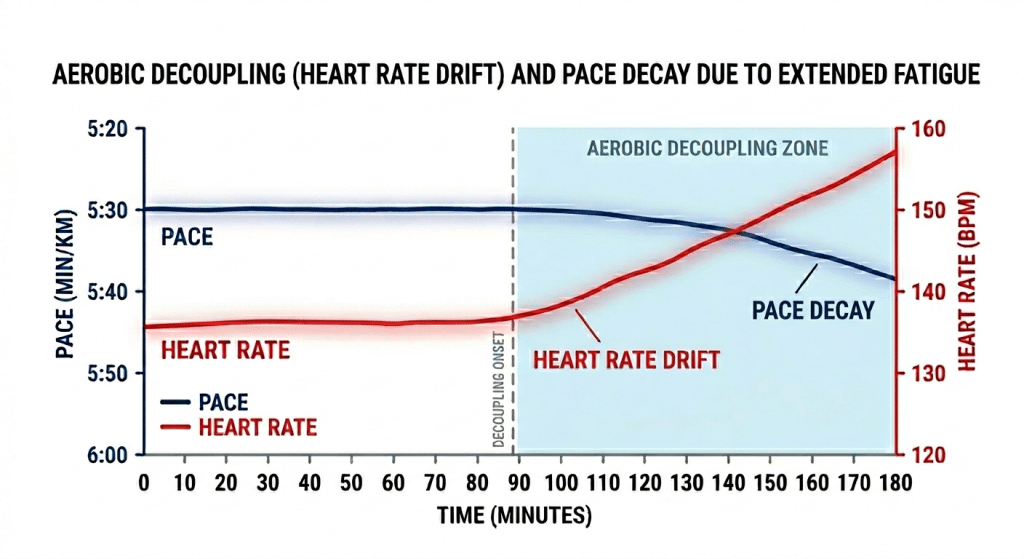
The most accessible indicator of durability breakdown is decoupling—also called aerobic decoupling or heart rate drift. Unlike VO2max or lactate threshold, which typically require lab testing, decoupling can be tracked during any standard training session with nothing more than a GPS watch and a heart rate monitor.
Look for the point where internal effort and external output begin to diverge. Heart rate climbs while pace stays flat or begins to drop. Early in a run, the two track closely together. As fatigue builds, that relationship breaks down, and the body has to work harder to achieve the same result. That’s also noticeable in increased perceived exertion.
The earlier divergence appears in a session or race, the lower the athlete’s durability. This is the smoking gun that coaches and athletes should be looking for in their training data.
What Drives Decoupling?
Decoupling doesn’t have a single cause. It’s the result of several systems deteriorating more or less simultaneously as fatigue builds:
- Cardiac Drift: Plasma volume drops, stroke volume falls and the heart beats faster to maintain the same output, even at steady intensity.
- Heat: A rising core temperature diverts blood to the skin for cooling, leaving less available to working muscles and accelerating the heart rate.
- Fueling: As glycogen availability declines, the body becomes increasingly reliant on fat oxidation, resulting in lower maximal ATP production rates and making it more difficult to sustain higher outputs. Underfueling accelerates the decline in performance much earlier than most runners expect.
- Pacing: Starting too fast increases early glycogen use, raises core temperature sooner and strains the cardiovascular system. Problems that appear hours into a race often begin in the first hour.
- Mechanical Fatigue: Running economy deteriorates, stride efficiency declines and the energy cost of maintaining pace rises steadily throughout the run.
Trail Running Makes Decoupling Worse
Trail ultras speed up decoupling by taxing most systems simultaneously. Climbs drive cardiovascular and metabolic stress. Descents add eccentric muscle damage and mechanical strain. Unlike road running, the demands are never constant. They change continuously, and the breakdown happens faster as a result. Durability is such a decisive factor in trail racing that training for durability in your race preparation requires more than generic endurance work.
Build Your Aerobic Base and Go Long
The foundation of durability is a well-developed aerobic base. Consistent, low-intensity running improves fat metabolism, stabilizes cardiovascular responses over longer durations and delays the onset of cardiac drift. Research confirms that both low- and high-intensity training improve durability, but through different mechanisms, and that low-intensity volume is especially relevant for the sustained, moderate-effort demands of trail ultras.
Long runs are where that base gets stress-tested. A 2026 study by Zanini and colleagues found that runners who regularly completed long runs and accumulated higher overall training volumes showed significantly better running economy durability than performance-matched peers, meaning their movement efficiency held up better as fatigue built. The long run wasn’t just building aerobic capacity; it was specifically conditioning the body to resist deterioration under prolonged fatigue.
For ultra preparation, some long runs should extend well beyond 90 minutes. These runs enter the territory where the things that matter most for endurance—efficient running form, the ability to hold a strong pace without going into the red and the ability to sustain a high percentage of your maximum aerobic capacity (VO2max)—start to noticeably break down.

Train Under Fatigue
One of the most effective and trail-specific strategies is deliberate fatigue stacking: training in a pre-fatigued state to simulate the physiological conditions of the late race.
Back-to-back long runs or well-structured multi-day training camps (I love them) are the most practical approaches in this respect. Running long on day one and again on day two forces the body to perform with glycogen partially depleted, muscles carrying residual damage and neuromuscular fatigue already present. This is a far better race-specific stimulus than a single long run followed by rest.
Other approaches worth building into your program:
- Finishing long runs with a set of hill reps (one of my favorite approaches)
- Including higher-intensity pickups during higher-volume training weeks
- Running a moderate effort in the evening and a long run the following morning
These methods are highly effective, but they must be introduced gradually and with caution. The athlete must possess the necessary tissue resilience and recovery capacity to withstand intense durability training without risking injury.
Strength Training and Downhill Conditioning
Strength training plays an important but often overlooked role in durability. It strengthens connective tissue, improving its resilience to the repeated mechanical forces of trail running, and helps preserve both movement quality and running economy as fatigue builds. These adaptations directly extend the window during which an athlete can run efficiently, delaying the breakdown that turns the back half of an ultra into a survival march.
For trail runners, downhill conditioning deserves equal attention. Descending creates a high eccentric muscle load, leading to microdamage, inflammation and progressive loss of force production. Research on the repeated-bout effect shows that regular downhill running exposure dramatically reduces subsequent muscle damage. Include weekly downhill-specific sessions, not just general trail running, and build the eccentric load progressively rather than saving it all for race week.
Fueling, Heat Management and Pacing as Durability Skills
These three factors are often treated as race-day logistics, but are actually trainable durability skills.
- Fueling: The ability to take in and utilize large amounts of carbohydrates (60-90 grams per hour, or more for well-adapted athletes) during prolonged efforts helps maintain energy availability and delays the metabolic shifts that accelerate fatigue. Practice this in training; the gut is trainable.
- Heat Adaptation: If the race involves warm conditions, deliberate heat exposure (passive or active) during race preparation allows the body to adapt by improving thermoregulation and expanding plasma volume, directly counteracting one of the primary drivers of cardiac drift.
- Pacing: Learning to start conservatively and control early effort can significantly extend the window of physiological stability. In many cases, better pacing alone delays durability breakdown more than any single training adaptation.
Summary
How to train durability for trail ultras comes down to targeted, consistent strategies, not a single magic session or workout type. Here’s the framework:
- Spot it first. Use heart rate and pace data in training to identify decoupling.
- Build a strong aerobic base. Low-intensity volume stabilizes cardiovascular responses and slows cardiac drift.
- Go genuinely long. Habitual long runs improve the durability of running economy.
- Stack fatigue. Back-to-back long runs or multi-day training camps and pre-fatigued sessions build race-specific resilience.
- Strength train. It builds tissue resilience and neural drive, helping to preserve neuromuscular output, movement quality and running economy as fatigue accumulates.
- Condition for downhills. Regular eccentric load reduces muscle damage accumulation.
- Train fueling, heat exposure and pacing. These are equally important skills.
Durability is often the deciding factor in long trail races. Two athletes with similar VO2max values can perform very differently late in an ultra. Train durability intentionally so the final miles of your race are a display of strength rather than a grueling grind.
The final article in this three-part series will explore the repeated-bout effect and why it plays such an important role in preparing for trail ultras.
References
Bontemps, B., Vercruyssen, F., Gruet, M., & Louis, J. (2020). Downhill running: What are the effects and how can we adapt? A narrative review. Sports Medicine, 50(12), 2083–2110. https://doi.org/10.1007/s40279-020-01355-z
Hunter, B., Maunder, E., Jones, A. M., Gallo, G., & Muniz-Pumares, D. (2025). Durability as an index of endurance exercise performance: Methodological considerations. Experimental Physiology, 110(11), 1612–1624. https://doi.org/10.1113/EP092120
Jeukendrup, A. (2014). A step towards personalized sports nutrition: Carbohydrate intake during exercise. Sports Medicine, 44(Suppl 1), S25–S33. https://doi.org/10.1007/s40279-014-0148-z
Matomäki, P., Kainulainen, H., & Kyröläinen, H. (2023). Durability is improved by both low and high intensity training in endurance athletes. Frontiers in Physiology, 14, 1128111. https://doi.org/10.3389/fphys.2023.1128111
Morin, J. B., Tomazin, K., Edouard, P., & Millet, G. Y. (2011). Changes in running mechanics and spring–mass behavior induced by a mountain ultra-marathon race. Journal of Biomechanics, 44(6), 1104–1107. https://doi.org/10.1016/j.jbiomech.2011.01.028
Périard, J. D., Racinais, S., & Sawka, M. N. (2015). Adaptations and mechanisms of human heat acclimation: Applications for competitive athletes and sports. Scandinavian Journal of Medicine & Science in Sports, 25(S1), 20–38. https://doi.org/10.1111/sms.12408
Zanini, M., Folland, J. P., & Blagrove, R. C. (2026). Regular long runs and higher training volumes are associated with better running economy durability in performance-matched well-trained male runners. Medicine & Science in Sports & Exercise, 58(1), 162–173. https://doi.org/10.1249/MSS.0000000000003840
Zanini, M., Folland, J. P., Wu, H., & Blagrove, R. C. (2025). Strength training improves running economy durability and fatigued high-intensity performance in well-trained male runners: A randomized controlled trial. Medicine & Science in Sports & Exercise, 57(7), 1546–1558. https://doi.org/10.1249/MSS.0000000000003685
About the Author
Gregor Rasp, CSCS and UESCA-certified ultrarunning coach, is the founder of Top Of The Trail, specializing in trail and ultrarunning. As an athlete himself, he has over 15 years of experience in endurance sports. His coaching focuses on understanding performance physiology and the long-term development of athletes. Visit TopoftheTrail.com or Top of the Trail on Facebook to learn more.