
The repeated bout effect is all about preparation. Once you’ve trained your legs for the downhills, you’re likely to experience less soreness, less muscle damage and a smaller loss of function, especially in the later miles of a trail ultra.
Article by Gregor Rasp, CSCS and UESCA-Certified Ultrarunning Coach

This is the final post in our series on durability for trail and ultrarunners. The first post explained why runners fade late in long races. The second post covered practical ways to build durability through long runs, back-to-back days, training camps and fueling strategies.
In this piece, we explore an important physiological mechanism for trail and ultra performance that deserves its own dedicated discussion: how the body learns to better tolerate repeated downhill exposure.
Why Downhills Break Runners
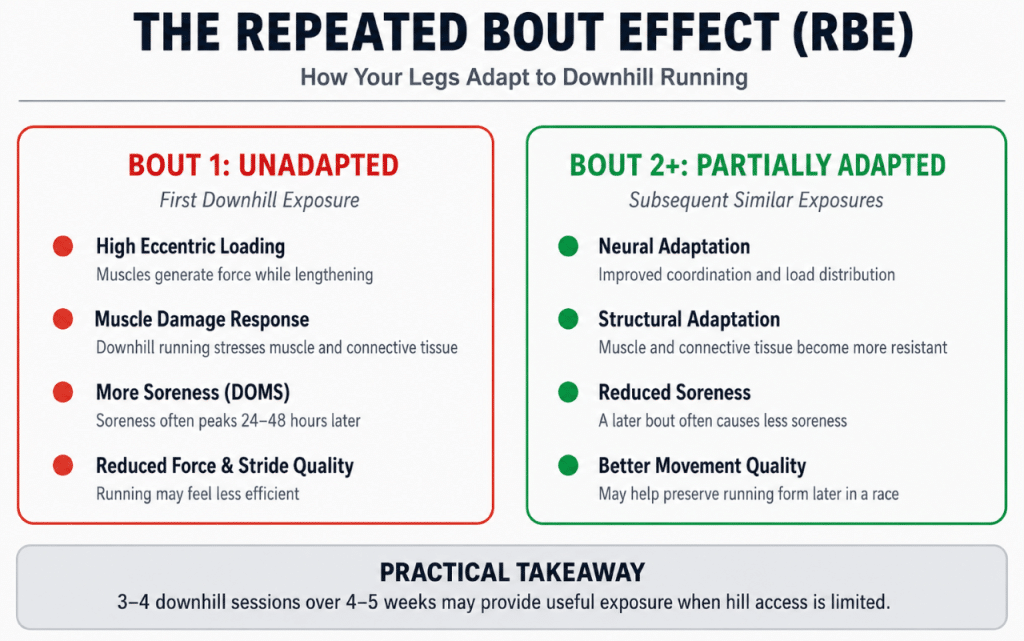
Many trail runners can climb well and move efficiently on flat ground, yet still fall apart after long descents. That’s because downhill running creates high eccentric muscle loading, especially in your quadriceps (thigh muscles).
Eccentric loading means your muscles generate force while lengthening, which places significant stress on the muscle-tendon unit. That stress can cause muscle damage, reduced force production and a less effective stride, all of which contribute to the late-race slowdown you might be familiar with firsthand.
What Is the Repeated Bout Effect?
The repeated bout effect (RBE) refers to the protective adaptation that occurs after an initial bout of unfamiliar or damaging eccentric exercise. Once you’ve been exposed to that stress, a similar bout later usually causes less soreness, less muscle damage and a smaller loss of function. Your body adapts to that stress and remembers.
For trail and ultrarunners, think of the RBE as descent-specific resilience. That matters because your goal isn’t just to survive the race, it’s to keep moving well after hours of climbing and descending. Once you’ve prepared your legs for the downhills, you’re more likely to still be moving well late into the race.

What’s Actually Happening in Your Legs
The exact mechanisms are not yet fully understood, but the repeated bout effect appears to involve several overlapping changes working in your favor.
Some adaptations are neural. Your nervous system may learn to distribute load more effectively and coordinate movement more efficiently. Others are structural, involving your muscle fibers, connective tissue and the muscle-tendon system itself. The net effect: better protection against that same stress next time.
Prior eccentric exposure often reduces soreness and certain damage-related responses, which may help you preserve movement quality later in a race.
How Much Downhill Exposure Do You Need?
You don’t need months of mountain training to benefit from the repeated bout effect. A few well-timed exposures can build useful protection, which is great news if you live somewhere flat. One recent study found that 10 downhill sessions reduced perceived quadriceps soreness after downhill running, though neuromuscular fatigue responses didn’t clearly improve.
You may not need that much volume to see real-world benefits. As a practical compromise, aiming for just three to four downhill-running sessions within a four- to five-week block may provide useful exposure when regular access to hills is limited.
The ideal situation is regular access to hilly terrain, because mild, repeated downhill exposure helps keep the legs familiar with the demands of descending. But that does not mean runners should hammer steep downhills year-round. Hard downhill sessions carry a high recovery cost and may increase the risk of injury if overused. For most athletes, a better approach is to maintain some gentle downhill exposure when possible, then add a more focused downhill-specific block closer to race day.
When to Schedule Downhill Work
Keep in mind, the RBE isn’t permanent, but meaningful protection can last several weeks. For race preparation, a four- to six-week window is useful. If you can’t start earlier, a focused block six to eight weeks out is a reasonable fallback.
Because demanding downhill sessions can cause soreness and temporary performance loss, don’t schedule them too close to race day. For most runners, the last meaningful downhill-specific session should be completed no later than three weeks before race day.
For runners new to structured downhill training, the aim is controlled, progressive practice. Start with moderate grades and nontechnical terrain, then gradually increase your descending volume, technical difficulty or duration based on your goal race’s requirements. More experienced trail runners may be able to progress faster, but the principle is the same: Expose the legs, don’t destroy them.
Can Strength Training Substitute?
Eccentric strength training can trigger the RBE, but it won’t fully replace downhill-specific training. You still need real downhill exposure to get the trail-specific benefit. That said, stairs, bridges and treadmills set to a negative grade aren’t useless. They can help prime your legs before you get into actual downhill-specific work.
The Bottom Line
The repeated bout effect is a key mechanism for durability and an important part of your race preparation. Repeated downhill exposure can make you more resilient late in long races.
Training means preparing your body for the specific stresses of race day, and downhill running is one of them. Show up at the start line with legs that are already adapted, so the back half of your race doesn’t turn into a grind.
References
Bontemps, B., Louis, J., Owens, D. J., Mirić, S., Vercruyssen, F., Gruet, M., & Erskine, R. M. (2025). Muscle soreness but not neuromuscular fatigue responses following downhill running differ according to the number of exercise bouts. European Journal of Sport Science, 25(3), Article e12240. https://doi.org/10.1002/ejsc.12240
Cleary, M. A., Kimura, I. F., Sitler, M. R., & Kendrick, Z. V. (2002). Temporal pattern of the repeated bout effect of eccentric exercise on delayed-onset muscle soreness. Journal of Athletic Training, 37(1), 32–36. Free full text: https://pmc.ncbi.nlm.nih.gov/articles/PMC164305/
Hyldahl, R. D., Chen, T. C., & Nosaka, K. (2017). Mechanisms and mediators of the skeletal muscle repeated bout effect. Exercise and Sport Sciences Reviews, 45(1), 24–33. https://doi.org/10.1249/JES.0000000000000095
Lu, Z., Suo, B., Deng, L., Wang, J., Fu, W., Zhong, Y., & Jin, J. (2025). A review of uphill and downhill running: Biomechanics, physiology and modulating factors. Frontiers in Bioengineering and Biotechnology, 13, Article 1690023. https://doi.org/10.3389/fbioe.2025.1690023
Martinez-Navarro, I., Vicente-Mampel, J., López-Grueso, R., Suarez-Alcazar, M.-P., Vilar-Fabra, C., Collado-Boira, E., & Hernando, C. (2026). Downhill running-induced muscle damage in trail runners: An exploratory study regarding training background and running gait. Sports, 14(1), Article 12. https://doi.org/10.3390/sports14010012
Maunder, E., Seiler, S., Mildenhall, M. J., Kilding, A. E., & Plews, D. J. (2021). The importance of ‘durability’ in the physiological profiling of endurance athletes. Sports Medicine, 51(8), 1619–1628. https://doi.org/10.1007/s40279-021-01459-0
Tallis, J., McMorrow, C., Shelley, S. P., & Eustace, S. J. (2024). Repeated bout effect of downhill running on physiological markers of effort and post exercise perception of soreness in trained female distance runners. Sports, 12(6), Article 169. https://doi.org/10.3390/sports12060169
About the Author
Gregor Rasp, CSCS and UESCA-certified ultrarunning coach, is the founder of Top Of The Trail, specializing in trail and ultrarunning. As an athlete himself, he has over 15 years of experience in endurance sports. His coaching focuses on understanding performance physiology and the long-term development of athletes.
Website: topofthetrail.com Facebook: topofthetrail











So how does a coach program for this? I can’t think of a local route or trail I could prescribe that would provide more downhill than uphill. If an athlete runs varied terrain and trails, what goes up must come down, so they hit both uphill and downhill running mechanics. This certainly seems to apply more to those who live in flatter areas without the benefit of varied trail networks. I fear this will lead an inexperienced athlete to think they need to get a ride uphill, then bomb down and repeat, creating muscle damage and fatigue they never fully recover from.
Great question Wes and an important clarification to make is that downhill training doesn’t mean there needs to be more downhill than uphill. To your point, if doing downhill training out on trails, there will always be uphill as well. This article isn’t suggesting that downhill sessions are ONLY downhill. Programming will primarily gradually include more and more downhill running, and gradually increase how technical and steep the downhills are. The main point is that the body needs exposure to downhill running in order to adapt for the demands of race day (for races that require downhill running). Expose legs to the stress but don’t destroy the legs in the process.
Thanks for raising this, Wes. Cindy basically covered the essentials in her comment. I’d add that “downhill-specific” doesn’t mean creating a workout with more downhill than uphill. It means deliberately providing and progressively developing the eccentric loading that comes from descending.
For an experienced trail runner who regularly trains on mountainous terrain, there may be less need for separate downhill-specific sessions because that athlete already gets repeated exposure. It becomes much more important for runners preparing for mountainous races who do not have regular access to that terrain.
If an athlete is essentially downhill-naive, I would start conservatively. Eccentric strength training can help prime the legs before introducing more specific downhill running. But strength training does not replace actual downhill exposure.
You also don’t need a mountain. If you only have a short downhill stretch, controlled repeats can work well—perhaps walking back uphill and jogging or running down.
What I would avoid is an inexperienced runner interpreting “downhill training” as a license to imitate the spectacular high-speed descending we sometimes see from elite runners on social media. Bombing downhill and creating as much muscle damage as possible is counterproductive and unnecessarily risky. The goal is sufficient, progressive, race-relevant downhill exposure—not maximum eccentric damage. As the article puts it: Expose the legs, don’t destroy them.